
Table of Contents
Analyzing Affiliate Marketing Metrics: What Really Matters
The rapidly developing digital network has created ideal conditions for online retailing. Online commerce has long since become a familiar part of our lives, but interest in it only grows yearly. More and more business spheres are moving to the online space. That is not surprising, as it is much easier and more profitable to sell goods/services online than offline.
Due to high competition, companies face numerous customer acquisition and retention challenges. In this situation, affiliate marketing comes to the rescue. This promotional concept has proven to be a powerful tool for increasing consumer loyalty and profit.
For businesses, affiliate marketing can replace a sales department, while for partners, it can become a reliable source of income.
What are affiliates in marketing? Is affiliate marketing profitable? How do you measure its effectiveness? We have prepared an article that answers the most common questions about affiliate marketing and explains how it helps with online sales.
Affiliate Marketing: A Brief Overview
Affiliate marketing is a model of interaction between sellers and partners (affiliates).
- What are affiliates? They are website owners or publishers of advertising content who promote other companies’ products or services. Typically, affiliates do not have their online stores or products to sell. Instead, they use their resources and channels to promote other stores and services in exchange for a share of the revenue.
The history of affiliate marketing dates back to 1989. The concept was conceived, implemented, and patented by William J. Tobin, the founder of PC Flowers & Gifts. He launched an affiliate program on the Prodigy network, sharing a commission for each sale. After 4 years, it was generating over $6 million annually for the network. Many other companies began adopting this idea. Today, affiliate marketing is the most popular concept for promoting products and services.
- According to Google Trends data, the number of queries for “affiliate marketing” more than doubled from 2015 to 2022.
The core principle of this concept is mutually beneficial affiliate lead generation, where both sides benefit from the collaboration. Do not confuse it with a referral marketing program, as affiliates do not necessarily have to be existing customers. However, even if they are not customers, they must have an audience that includes the company’s target market.
How Does Affiliate Marketing Work?
As an affiliate marketer, you can succeed tremendously in the competitive online environment by attracting and retaining new leads.
If you’re new to the game, here’s the structure of a lead generation affiliate program and how all the parties within it interact:
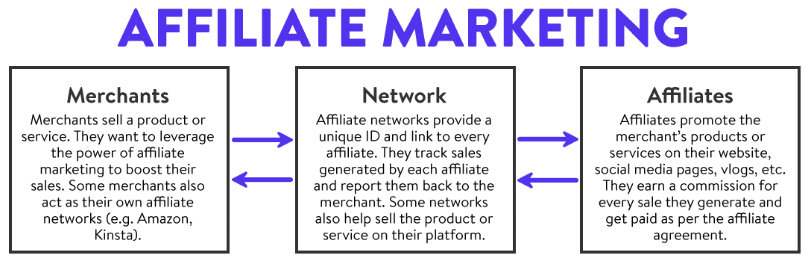
Source: Kinsta
If it still looks confusing, and you feel like you’re missing out on something, here is the lead generation affiliate marketing process in a nutshell — a simple explanation of every stage involved in the process:
| Stage | Description |
| Establishing affiliate relationships | Companies and affiliates enter into a partnership agreement, defining the rules and conditions of the partnership, including the commission size or other forms of compensation. |
| Providing unique links or promo codes | Affiliates receive individual links or promo codes from the company. These enable tracking of their activity and recording sales made through their efforts. |
| Launching product promotion | Affiliates use their websites, blogs, social media, and other distribution channels to promote the company’s products or services. They create content containing links or promo codes to attract their audience. |
| Running lead generation affiliate campaigns | Affiliates promote the products or services to their audience. The company tracks these actions when customers click on unique links or use promo codes. |
| Structuring commissions | If affiliate marketing leads purchase through an affiliate link or promo code, the partner receives a commission according to the agreement’s terms. |
| Tracking and analyzing results | The company uses special tools and affiliate commission tracking software to monitor the sales generated by partners and assess program effectiveness. This optimization allows for making informed decisions. |
Source: BigCommerce
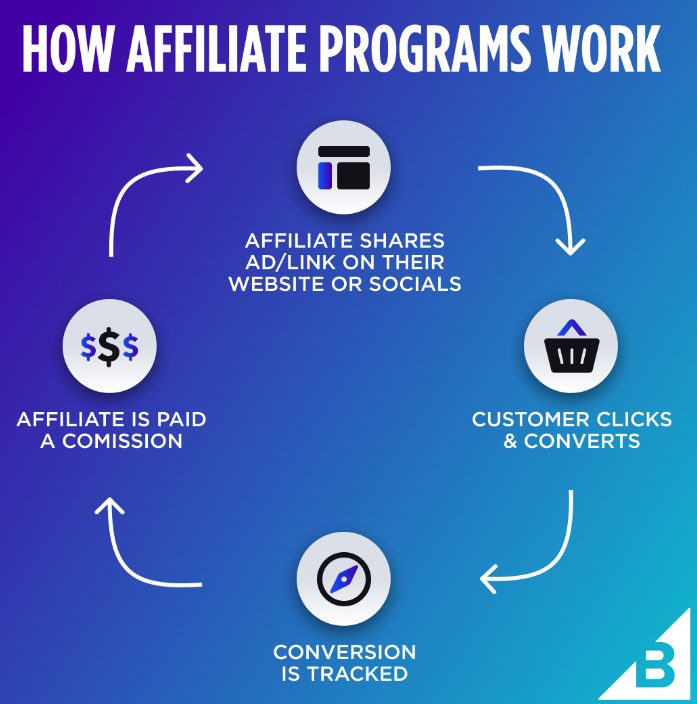
Affiliate marketing lead generation provides companies, solopreneurs, and networks an effective way to expand their audience and attract new customers. At the same time, partners gain an additional source of income for promoting products or services. This approach enables long-term partnership relationships and joint success.
Types of Affiliate Marketing
When we refer to types, we’re talking about the forms of collaboration and fees. But how does a seller determine the effectiveness of an affiliate’s actions?
To get an answer to the question, you must understand the standard strategies employed by networks, advertisers, and affiliate program owners:
- Cost Per Click (CPC): The company pays affiliates every time a user clicks on one of their affiliate links.
- Cost Per Lead (CPL): This model implies advertisers pay for the quality affiliate leads generated for a specific offer in a particular niche, like insurance, loan, call, healthcare, SaaS, and e-commerce leads.
- Cost Per Acquisition/Action (CPA): This model implies that partners are paid for predefined actions (mandatory for completion) like a purchase, sign-up, download, etc.
As an affiliate marketer, you need to consider your target audience’s needs and your company’s business model to choose the best option to maximize your collaboration’s results.
Advantages of Affiliate Marketing
Since its inception, the popularity of affiliate marketing has been growing steadily. As of 2023, this industry is valued at $17 billion; by 2030, it’s expected to reach $40 billion. These affiliate marketing stats are attributed to the numerous benefits that businesses gain.
Direct Payment for Sales/Other Targeted Actions
When investing in traditional advertising, business owners have to pay for every click or, in the best case, for engaging a potential customer.
In the next stage, affiliate leads need to be converted into paying customers, which also requires expenses. In the case of a partnership, you only pay for actual sales. If an affiliate doesn’t bring you customers, you are not obligated to pay them a commission. This approach makes marketing more cost-effective.
Access to a “Warm” Audience
The advantage of partnering with affiliates is that they typically have an established audience that trusts them. This simplifies building relationships with these people since the affiliate represents your company and its products/services favorably.
Multi-Promotion of Product
All partners are directly interested in selling your product or service because they earn a commission for each customer. They employ various methods to promote your brand to achieve the best results.
Choice of Partners
Potential affiliates apply to participate in the partner program. From the available applications, you select those of greater interest to you—those who, in your opinion, can provide access to the most loyal audience and represent the company and its products/services better than others.
All these advantages make affiliate marketing a vital tool for businesses, allowing them to expand their market opportunities and achieve higher results.
Affiliate Marketing Metrics: What To Focus On?
- What are marketing metrics? These measurements can tell you how well a company performs its marketing and advertising efforts.
How often do brands track the performance of their affiliate marketing program?
Around 38% of companies track metrics weekly, and 14% do so every two weeks. That means that just over half monitor their affiliate program metrics more frequently than once a month.
To effectively track the progress of your affiliate program, you need to make sure that affiliate marketing KPIs align with your company’s industry profile and business goals.
What Key Metrics Should I Track as an Affiliate Marketing Beginner?
Here are some of the most relevant affiliate marketing metrics to consider when evaluating your affiliate program:
Conversion Rate
It is one of the most crucial indicators that allow you to measure affiliate marketing, specifically its effectiveness. The conversion rate is the number of clicks on an affiliate link that resulted in a purchase.
- Formula: Number of desired actions / Number of visitors * 100%.
This metric also helps track each partner’s performance and identify those who convert customers the best, as well as which collaborations to pause.
Cost Per Action (CPA)
CPA allows you to assess an affiliate’s spending on a specific action, such as an order, purchase, subscription, or registration.
- Formula: Expenses / Number of desired actions
Return on Investment (ROI)
This is the income you receive from your affiliate program minus all expenses, such as affiliate commissions, the cost of affiliate program software, etc.
- Formula: (Income – Expenses) / Expenses * 100%
Percentage of Active Partners
A metric that allows you to assess the share of active participants in the affiliate program. Active partners typically perform actions that lead to sales or other conversions and are key to the program’s success.
- Formula: (Number of active partners / Total number of partners) * 100%
Earnings Per Click (EPC)
This metric is used to measure campaign effectiveness and assess the profitability of each click made through an affiliate link. EPC meaning in affiliate marketing is expressed in monetary terms and is calculated as follows:
- Formula: Earnings / Number of clicks
A high EPC indicates that each click generates significant income, while a low EPC indicates campaign inefficiency.
Customer Lifetime Value (CLV)
CLV is the income a customer brings over several years minus the initial costs of attracting them. CLV is an important metric for determining the cost of each customer and helps companies make decisions regarding customer acquisition and retention expenses.
CLV calculation can vary depending on the company and the nature of the business, but it usually looks like this:
- Formula: Average customer income over a specific period * Average customer “lifespan”
Overall Engagement
This is a rather complex metric that includes:
- The number of visits to your site through affiliate links
- The number of affiliate links leading to your site
- The number of conversions generated by partners
You can calculate the metric in different ways, depending on the specific metrics and platforms on which it is measured. For example, on social media platforms like Facebook, Twitter, or Instagram, overall engagement may include the sum of likes, comments, and reposts on a particular post or ad.
- Formula: (Number of likes + Number of comments + Number of shares + other actions) / Total views or unique users * 100%
Return Rate
This is the percentage of purchases made through an affiliate link that were returned or canceled. If the return rate exceeds 10%, it’s a sign that something is amiss with the partner.
- Formula: (Number of returning or repeat customers) / (Total number of customers) * 100%
Average Order Value (AOV)
AOV is the average amount customers spend purchasing goods or services through one of the affiliate links. If you sell a variety of products at different prices, this metric helps determine whether your partners are getting orders with higher values.
- Formula: Total revenue / Number of orders
Wrapping Up
Affiliate marketing is an effective and popular method for promoting products and services in which the advertiser pays only for specific results.
A well-executed approach to affiliate marketing always pays off and offers numerous advantages for both large and small businesses. It helps save budget on promotion, generates interest in the product, attracts new customers, and increases sales.